
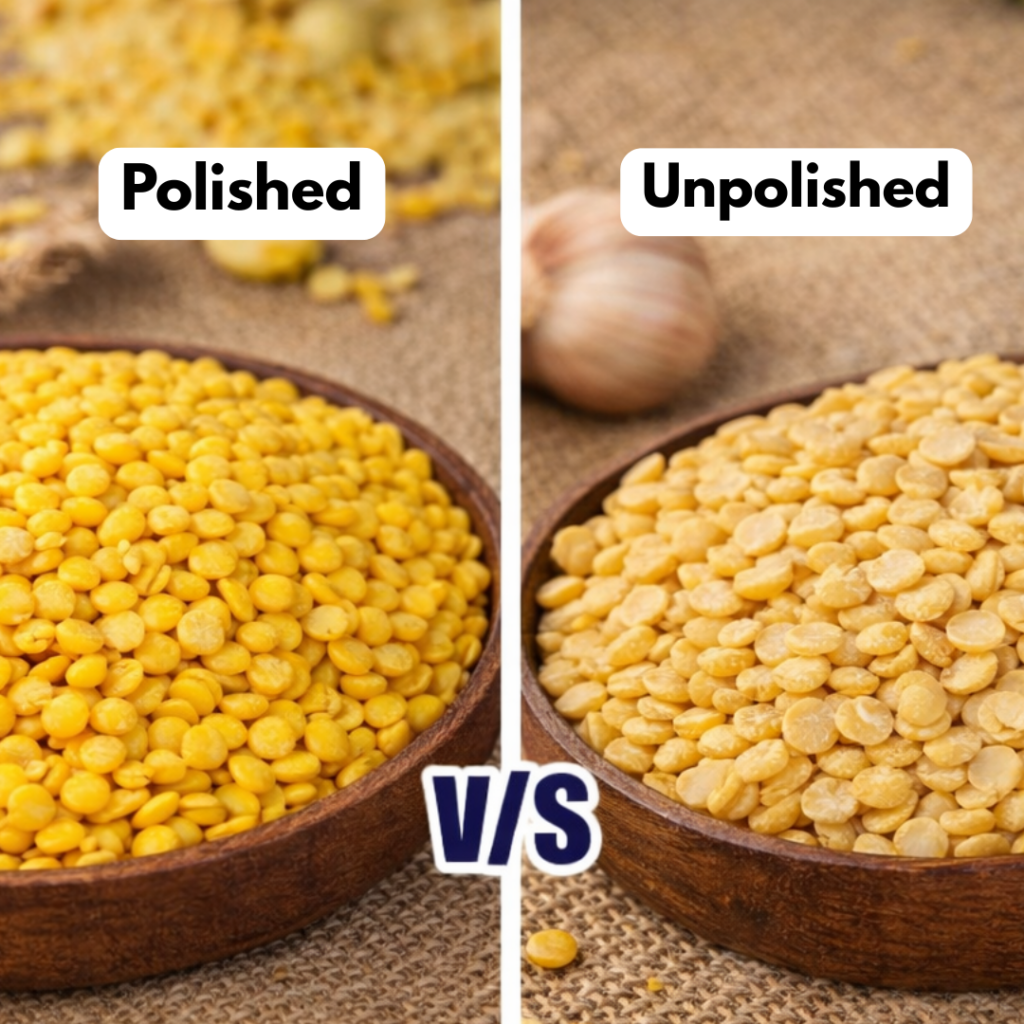
Dal is a daily part of Indian life. Whether it’s simple dal-chawal, comfort food after a long day, or a protein source in a fitness diet, dal quietly supports our health every single day. But recently, when you go to buy dal, you’ll notice two options: polished dal and unpolished dal. This applies to almost every variety of toor daal, whole masoor dal, moong daal, masoor daal, urad daal, chana daal, and mung daal, and many people don’t realize they are nutritionally different foods.
Most of us naturally pick the dal that looks cleaner and shinier. It feels fresher. But that shine is actually the result of processing, and during that process the dal loses a good portion of its natural nutrition.
What Is Polished Dal?
Polished dal is lentil that has been processed after milling to make it visually attractive. The outer layer is removed, and the grains are rubbed in polishing drums using oil or water so they appear smooth and glossy.
Because of this process, polished dal:
What Is Unpolished Dal?
Unpolished dal is much closer to its natural form. It is simply cleaned and split with no artificial shining or rubbing.
It may look slightly dull, uneven in color, or have tiny marks. That’s normal. In fact, that is a sign that the dal still contains its natural outer layer.
Because it is minimally processed, unpolished dal keeps:
Key Difference at a Glance
| Feature | Polished Dal | Unpolished Dal |
| Processing | High | Minimal |
| Look | Shiny | Natural |
| Fiber | Low | High |
| Nutrition | Reduced | Intact |
| Digestion | Quick | Gradual |
| Energy | Short | Sustained |
| Fullness | Less | More |
What Happens Inside Your Body?
This is where the real difference matters. Polished dal digests quickly because fiber has been removed. When digestion is fast, sugar enters the bloodstream rapidly. You feel hungry again sooner, sometimes within a couple of hours.
Unpolished dal digests slowly. The body absorbs energy gradually, so you stay full longer and avoid unnecessary snacking. This is why people often feel more satisfied after eating unpolished moong daal or whole masoor dal compared to polished versions.
Health Benefits of Unpolished Dal
Regularly eating natural dals can support overall health in multiple ways:
Because of this, many dieticians recommend unpolished chana daal, urad daal, masoor daal, and toor daal in daily meals.
Unpolished dal works differently:
This effect is especially noticeable with whole masoor dal and chana dal, which naturally contain more fiber.
Who Should Prefer Unpolished Dal?
You will especially benefit if you:
Even replacing one daily meal—like switching to unpolished toor dal—can make a noticeable difference over time.
Is Polished Dal Bad?
Not really. Eating it occasionally is fine. The issue comes when it becomes your everyday staple. Over time you consume less fiber and fewer micronutrients, even though you feel like you’re eating healthy. So polished dal fills the stomach. Unpolished dal nourishes the body.
How to Identify Unpolished Dal
You can easily recognize it while shopping:
If dal looks too perfect, it’s usually polished.
Choose polished dal if:
Choose unpolished dal if:
(FAQs) Polished Dal vs Unpolished Dal
1. What is the main difference between polished dal and unpolished dal?
Polished dal is processed to remove the outer fiber layer and make it shiny, while unpolished dal is natural and minimally processed. Because of this, unpolished dal contains more fiber, vitamins, and minerals, making it nutritionally better.
2. Does unpolished dal taste different from polished dal?
The taste difference is very small. Unpolished dal has a slightly nuttier and richer flavor, while polished dal tastes more neutral. After a few days of regular eating, most people do not notice much difference
3. Which dal is better for weight loss?
Unpolished dal is better for weight loss because it contains more fiber. It keeps you full longer and prevents frequent hunger. Polished dal digests faster and may lead to overeating.
4. Is unpolished dal good for diabetes?
Yes. Unpolished dal helps control blood sugar levels because fiber slows down glucose absorption. It prevents sudden sugar spikes and provides steady energy.
5. Does unpolished dal take more time to cook?
Only slightly. It may take about 5–10 minutes more. Soaking the dal for 20 minutes before cooking reduces the cooking time to almost equal to polished dal.